The Boys at Blew Dog's: What makes a leader? Character or credentials?
The lessons began at age four.
“Don’t open that door for anyone,” Nana said. “I don’t care what he says he’s here to fix. I don’t care if he shows you a policeman’s badge. You do not open that door. Do you hear me?”
At age five, around the time of the divorce, my mother’s lessons began too. “Never let a man hit you. Once a man hits you, you always have to live in fear of him.”
So as a teenager, when my mother’s boyfriend was drunk and climbing up the side of the house, trying to get in through the window, I didn’t hesitate. I called the police. They came and arrested him, and all was calm again.
And then years later, when a retired Vietnam vet who was drunk in the afternoon explained, “I don’t need to be governed,” I was suspicious.
It was 2002 and I’d signed up for a week of surf camp at Safari Surf School in Nosara, a remote community on Costa Rica’s Nicoya Peninsula, in the province of Guanacaste.
Terrain: jungle
Population: 500
I’d never seen a place like Nosara. Never even imagined such a place.
It was July, rainy season. We’d flown from New York to San José only to learn our flight to Nosara had been canceled due to the weather. Among the swarm of taxi drivers offering rides, we were approached by a scruffy older American couple who lived in Nosara and suggested we share a car.
My guy-friend and I just stared at each other. Finally, he spoke. “They look alright.”
The husband sat up front with the driver and the wife squeezed in back of the little orange sedan with my friend on the left and me in the middle.
Turns out, they were more than alright. They were lovely. The wife chatted on throughout the ride about what a treat we were in for. How Nosara was a special place. She told us how the roads were paved with molasses during the dry season to keep the dust under control, and how delicious that smelled. She explained that the food in Nosara was much healthier than what we were used to in the U.S. The soil was healthy; the cows were healthy. She raved about how fertile the land was, how “you put a bunch of sticks in the ground and a few months later, you have yourself a fence.”
“Yup,” her husband would agree. “They do things different here.”
She joked about how easy it was to get pregnant in Nosara. “Everyone’s pregnant here. Even the dogs. You’ll see.”
We drove for hours in heavy rain. At one point our taxi took a ferry. We made the quickest stop at a restaurant in Nicoya. Our driver said we only had a few minutes to use the restroom. If we were hungry, we could order food to go and eat it in the car. It was getting late and there was no way we could do the hard part of the ride in the dark.
If I had known what I was getting into, there’s no way I would’ve agreed to ride in a tiny, low-clearance sedan to Nosara during rainy season. Not back then, anyway. We should’ve gotten a hotel room in San José and taken the first flight to Nosara the next day.
But there was no going back now.
Trees were down, blocking the road. A truck had gotten stuck where the river was flowing. Our driver got out of the car a couple of times to assess the situation before moving forward. There were a few impromptu meetings with others making the treacherous journey. I stayed silent in the back seat watching our driver gesticulate with locals in the mud.
I don’t know how we made it, but we did.
The rain had subsided as we began to see wooden, hand-painted street signs. The wife rolled down the window and took a deep inhale.
Then I did too.
The sheer volume of plant life was intoxicating. My lungs had never felt air like this before. Every breath was a delight. This is the air God meant for us to breathe, I thought as we said our goodbyes.
(And it really was goodbye. We never saw that couple again.)
I checked into my sweet simple room at Casa Tucan just as it was getting dark. My friend’s room was a couple of doors down. It had been a long day. Definitely time for bed.
But I was on stripper time and couldn’t sleep. I unpacked. Read for a while. Did some yoga in my room. Then, around midnight, I felt cooped up and decided to take my journal out to the restaurant.
I walked past the pool to the open-air restaurant and had my choice of tables. They were all empty. There was a small gathering at the bar, so I chose a table far enough away to be in my own space. I opened up my journal and got to it.
At one point, I looked up and caught a white-haired, grizzled surfer looking at me. He quickly turned back to his friends.
A cold wave of fear washed through me. I was a woman, alone in the pitch black of the Nosara night. I knew the road was just a few feet away. But without street lights, I couldn’t see it.
I thought about what all the men drinking at that bar might be thinking of me. To them, it must’ve seemed like I was looking for something. What else would I be doing there? I was asking for trouble.
My mother’s words went through my head. I was in middle school when she told me: Don’t tease the boys. You’ll get yourself raped.
Not that, at twelve, I had ever teased the boys. Or even knew what it meant to tease the boys. But my mother probably saw me turning into a woman and thought it was time to share that bit of wisdom.
I immediately closed my journal and went straight back to my room. I didn’t even look toward the bar. Thank God no one followed me. They left me alone.
The next day, I met the retired Vietnam vet on the beach. “You were up late last night,” he said. He’d been one of those men drinking at the bar.
“Yeah, I couldn’t sleep. Guess I was too excited to get this surf adventure started.”
I was friendly, feeling safe on the beach in broad daylight, in the company of my fellow surf campers.
The morning had been glorious. We ate a delicious breakfast together in that same restaurant which felt so menacing just hours before. By this time I’d already seen the Howler monkeys and the little rainbow crabs scurrying in the brush. I’d made friends with the cuddly beach dogs. I was fully enchanted with Nosara. And so was everyone else. People kept referring to it as “paradise.”
But after the previous night, I knew better.
“What if I wanted to live here by myself?” I asked the old veteran. “What if I wanted to buy a house here and live as a writer, just me and my dog?” I didn’t have a dog at the time. But these beach dogs sure had me wanting one.
He thought it over for a moment. “Get a gun,” he said.
In less than 24 hours, I understood the limits of this paradise. It was untouched and wild—with all the beauty that entails. And all the danger, too. I’d be fine during the day, especially in a group. But alone and at night? Well, that was another story.
Still, Nosara won me over. I knew I’d be back to write. And a few years later, I started doing exactly that. Nosara became my home away from home, my writing retreat, my respite from the fast life I lived in New York. I’d spend weeks and months there at a time, keeping an eye out for my safety, just like I’d always done.
I made friends in Nosara and I still love these women today. They knew they were “goddesses” and weren’t afraid to say so.
But even goddesses aren’t invincible. When we made plans to meet for a drink after dark, we showed up for each other on time. The ratio of men to women in Nosara was far from even. And though we recognized most of the men—we’d see them on the beach and around town all day—it still felt uncomfortable to be the only woman in a bar waiting for friends to arrive. We made every effort not to put each other through it.
Now, I’m not suggesting the men in Nosara were threatening. Not at all. They were mostly nice guys. Surfers. They respected Mother Nature. They knew to never turn your back on the ocean and that where your eyes go, your body follows.
But I wouldn’t exactly call these boys polished gentlemen either. Their hair was wild, their skin weathered. Many couldn’t be bothered to wear shoes. When they weren’t surfing, they played pool or went fishing. They drank. There was a brothel a mile or so inland, near the airstrip. I couldn’t believe such a small community tolerated a brothel—and just a short walk from the church. I guess it provided an essential service.
Truth is, back in the early 2000s, Nosara was a place that attracted its share of misfits. Everyone had a story. And they loved to tell it. It was a running joke that the women were running away from relationships and the men were escaping corporate life. We were all rejecting traditional scripts. And as a stripper, no one more so than I.
No one hassled me about it. No one even really mentioned it. I heard that my real estate agent was talking behind my back—saying that I was nice and kept my place clean.
One of the goddesses went so far as to say, “I don’t care what you do in New York. You’re my friend.”
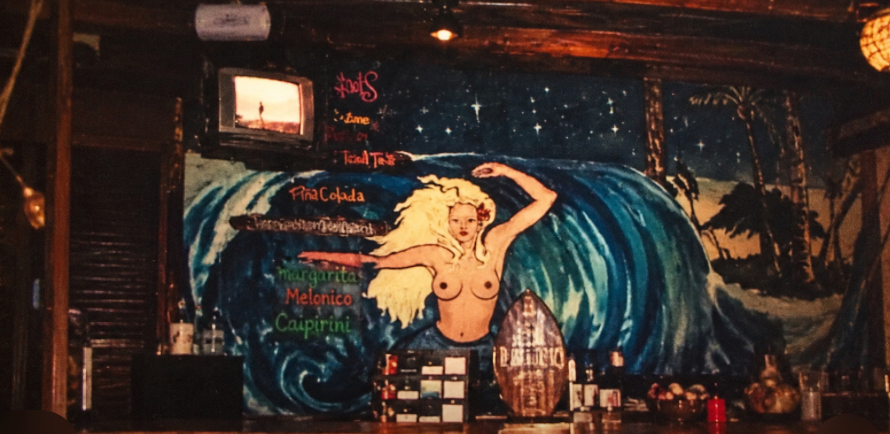
But there was some behavior Nosara didn’t tolerate at all. I learned this in no uncertain terms one night at Blew Dog’s—when the one guy in town who did, in fact, give me the creeps rolled in.
He’d only been around for about a week. I never had any run-ins with him myself. I’d see him at a distance and avoid him. Something about his energy was off. I heard he’d been sleeping on the beach instead of renting a room. Nosara was welcoming to backpackers. Wanderers. I think the hostel only charged $15 a night. And I bet if he’d offered to work, he could’ve stayed for even less. Maybe even for free. That was the vibe in Nosara back then.
So sleeping on the beach was frowned upon. But what really had people upset was that he was harassing women.
There was one band in town at the time. I’m sure they had a name. But I only ever knew them as The Band. And when they played, everyone came out. Whatever bar they’d booked was the only place to be that night. And on this particular night, the band was playing at Blew Dog’s.
The place was packed. Dinner was just ending. Tables were being cleared and The Band was setting up. Most of us were in our 20s or 30s. But there were plenty of grey beards in the crowd too. New moms swaddling infants. Toddlers ran around, dogs ran around. The town dogs were welcome at all the open-air restaurants. They were well loved and well fed.
It was nice to see children in bars. I know that’s a weird thing to say. Especially when the drug dealers were there too. Even if it was your first day in town, it was pretty clear who the drug dealers were. Something about the way they hung out in the corner by the restrooms, leaning up against the bar, was revealing. There was a house on the beach in Playa Pelada that seemed to be their home base. I avoided walking past. I always pictured black crows circling over it.
I liked seeing the children. I liked seeing the whole town gather. Some of the locals would show up too, not just the international surfing crowd. I liked hearing different languages spoken all around me. I was used to that in New York and it was nice to experience this in Nosara as well.
I was enjoying a glass of white wine with the girls when a voice above all others grabbed everyone’s attention. “Hey man, get the fuck out of here.”
The Wanderer had wandered in. Just barely. He was still at the entrance when the first man got up from his dinner and moved toward him.
It was one of those moments where the needle scratches the record. We all froze as one man after another stopped whatever he was doing—put down his beer, his pool cue—until the Wanderer was facing an impenetrable pack of dudes.
He tried to defend himself. He looked small, a skinny, blond white guy facing an angry mob. His voice sounded small. “I’m just here to have a drink. It’s cool.”
Clearly, it wasn’t cool. The mob kept moving toward him. Slowly. I held my breath waiting for the moment it all explodes.
There were a couple of escape routes. I could easily run to safety if I had to.
I watched as the mob moved forward and the Wanderer backed up, still rambling, terrified, about how he just wanted a beer.
Finally, someone yelled, “We’re doing you a favor, man. We could beat the shit out of you. Just get out.”
And that was the end of it. The Wanderer left. We all took a breath and the fun buzz of the night picked up where it left off.
This moment has lived inside me all these years. I was expecting a violent scene. But it never happened. And it absolutely could have. There were exactly two policemen in Nosara at the time and they were not at Blew Dog’s that night. I’d never actually seen them myself. They weren’t a presence at all. A friend told me that until the owner of Café de Paris bought them a car, they traveled on horseback.
The boys at Blew Dog’s could’ve beaten the crap out of that weird guy if they wanted to. They could’ve even killed him. It would’ve been so easy to get rid of the body.
I knew I’d witnessed something powerful. But I wasn’t yet mature enough to fully grasp its significance.
Now I understand. Those men weren’t just doing the Wanderer a favor. By not resorting to violence, they did us all a favor. They did the entire community a huge favor by not poisoning our paradise with violence.
If there had been a bar brawl, or, God forbid, a murder, how would that have changed things?
Would parents continue showing up to Blew Dog’s with their kids in tow? Would my girlfriends and I, already cautious about nightlife in Nosara, ever go out again? Maybe we’d only feel safe gathering at home.
Would The Band have even played that night?
What I couldn’t put into words at the time was that the Boys at Blew Dog’s were demonstrating what healthy masculinity looks like. They demonstrated what power looks like when it’s exercised with restraint. They demonstrated what respect for women looks like.
Nosara was very permissive back then. There was no real authority except what the men who lived there allowed. And those men did not allow harassing women.
I never saw the Wanderer again.
What I do see, time and again, maybe now more than ever, is the abuse of power. I see power exercised without much restraint at all. I see power exercised without concern for the effect it has on the larger community. I read about it in the papers every day—sometimes in language so sanitized it’s just business as usual.
Where I’m from, we’re taught to regard polished, Ivy League types as leaders.
There’s nothing I hate more than polished manners covering up evil deeds. Outward refinement is no indication of moral character.
Where I’m from, the surfers in Nosara would be regarded as dropouts—not the best or the brightest. Certainly not leaders.
Credentials are a dime a dozen.
Actual character is not.